
 Camila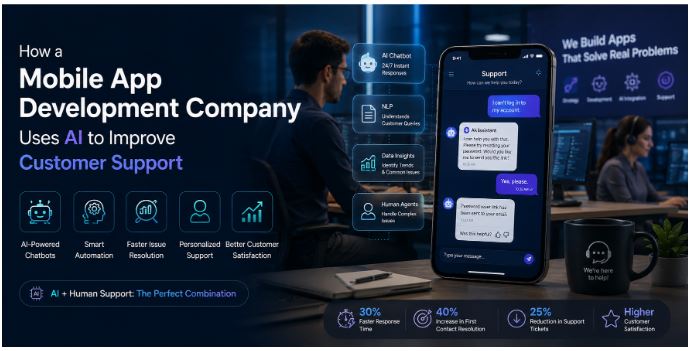
Marcus Okonkwo is a mid-sized ecommerce retailer of specialty outdoor products in the UK & Australia. Customer support consisted of eight agents who had to deal with issues in a common inbox, from returning goods to checking on orders, to filling warranty forms, complaints about damaged products and sometimes even having to give recommendations on what to buy between two people standing in the middle of a trail trying to figure out which one to purchase.
Until it was not! The team’s Black Friday campaign was successful and inbound tickets have tripled overnight, and the team is spending the next six weeks clearing backlog. Three agents resigned in less than two months. Once Marcus finally hired a Mobile App Development Company to fix his customer facing app, he didn’t just give them a design brief. He didn’t want AI to be a chatbot on a side of the screen, but as the building blocks under the entire customer experience. His team developed what became not only the way support tickets were resolved, but also how many were necessary.
The move from Reactive to Predictive Support
Customer support is reactive as it’s meant to be. A customer has a problem, opens a channel, waits for response and gets help. But that sequence is only good for problems that are simple and volume is low. It is not as strong when pressure is applied and it fails to answer the customer’s questions which many customers don’t ask because of the friction of asking them.
The sequence of the changes in AI-powered support infrastructure is introduced by the prediction. The system can show the user help before he or she realizes that he or she needs it, by using the data from the app to determine which screens the user visits before dropping out, how long he or she spends on a particular step, which error states the user is hitting again and again, and so on. If a shipping delay notice is sent in advance with a one-tap option to reschedule a shipment, the user will not have to create a support ticket. A contextual tip that appears when a user stops on a complicated return form will not have to have the follow-up call asking how to fill it out.
The development team placed behavioral triggers within each of the main user journeys of Marcus’ app. A proactive message was displayed on the order tracking screen if a user accessed this screen more than twice in 30 minutes, providing the status of the carrier and a direct link to the couriers “live” tracking. Order tracking questions experienced 41% less ticket volume in the first three months following launch.
Natural Language Processing and Intelligent Ticket Routing
There is no guarantee that all support interactions can be avoided. Where customers do communicate, however, the degree of their satisfaction or frustration depends largely on how much time it takes to have the right person see the right message. That routing has been revolutionized with the use of AI-driven natural language processing.
Modern NLP models can analyze incoming support messages, accurately categorize intent, and identify key entities such as order numbers, product names, and more, before a human even views the ticket. Warranty is submitted to the warranty team. Billing disputes are submitted to finance. Product question with commercial intent is not given to a support queue, but rather a sales-aware agent.
This is where sentiment analysis comes into play. Words with frustrated or urgent tone escalate automatically so when an agent receives a message from a truly frustrated or urgent customer, he or she is not sitting behind a queue of normal businesses. Marcus’ system identified high-sentiment tickets in less than 90 seconds after they are received. First response time of escalated tickets decreased from 4 hours to less than 20 minutes.
AI-Assisted Agents, Not AI-Replaced Agents!
A common misconception regarding AI in customer support is that it is designed to replace human agents. The firms that are seeing the most success with investing in AI aren’t eliminating their employees. They’re providing them with enhanced devices.
Agent assist technology is behind the support interface and functions in real-time. While reading an incoming ticket, the system automatically integrates order histories, account information, and past interactions in a single view; this avoids the need for manual effort across three platforms to find the answers. It can recommend response templates based on the category of the identified issue, identifies policy information that may be relevant to the customer’s situation and highlights previous contacts that may give context to the current query.
If you have a customer call support and tell them the package was late for return and they tell you that the package is the second time that they are returning it, you will trigger a flag in your system. The agent is in the position to see the history before typing a single word. The answer need not be a condemnatory expression of this pattern, as that would ‘take the wind out of the sails’ of the interaction.
Following the launch of the assist layer, agent handling time per ticket decreased by 28% for Marcus’s team. Agents said the thing that changed wasn’t necessarily the speed, it was the confidence. No longer had to second guess themselves when they were asked policy questions, the appropriate policy appeared automatically next to the appropriate ticket type.
When it comes to conversational AI, sometimes it’s okay to step back.
The reputation problem of AI-powered in-app chat is a legacy of years of poor customer service.The reputation problem with AI-powered in-app chat is a legacy of years of poor customer service stemming from frustrating bot interactions that failed to comprehend simple questions and couldn’t reach a human agent. That experience is very different from the experience of a properly designed conversational AI system today, and it lives on.
The difference is in the way things are escalated. A conversation AI that has its own capabilities, understands its limits, knows when a query has been beyond its training data or when it detects that a customer’s tone would suggest they need to talk to a human, without forcing them to repeat their entire story, provides a no-frustrating experience. The handoff contains every context, such as what the customer asked, what the bot responded, what information was retrieved from the account and more, so the next time the human agent is involved in the conversation, they know where to start.
Marcus’s app saw the conversational AI process 63% of the incoming chat volume without any human intervention, primarily sizing, return eligibility and shipping questions. On the other hand, average levels of satisfaction for those conversations that escalated were at least as high as they’d been prior to the inclusion of the AI layer, as agents were getting better-prepared “handoffs,” and less mental effort on triage.
Learning by doing and from others in all situations.
The best thing about AI support infrastructure over static knowledge bases and fixed decision trees is that it continues to learn as you go. Each and every item resolved in a ticket, each and every self-service interaction that is successful, each and every escalation pattern is fed back into the model. If a topic is having many tickets, it is a sign of either the lack of clarity of the product or documentation. Failure to resolve queries regularly with bots signals sparse training data.
Marcus’s development team added a monthly review cycle to the system; a dashboard showing the top ten type of unresolved queries in the previous month. These gaps were filled up in each cycle, either by making conversational AI more effective in dealing with that topic or by rectifying the product or communication problem that was creating the need to ask questions in the first place. At the end of 12 months of this loop, there was a 35% increase in the number of customers but a 22% reduction in the volume of inbound support.
What the Numbers Actually Mean
Marcus hired that team hoping to get through high season without adding to his team losses. What he received was a support operation that grew in scale without a proportional increase in staff, addressed more problems before they were turned into tickets, and provided his existing agents with the work that wasn’t as repetitive and was more impactful. His eight-person staff now serves three times as many customers as when they were on the verge of being overwhelmed by Black Friday traffic, and there’s been no turnover among agents in the last fourteen months.
AI tools don’t replace the human element of customer support. It’s a method to create a more sustainable, more skilled and more effective human side. The issue isn’t whether mobile app development teams should integrate AI into their support framework, but rather how they can.For enterprise and consumer app development teams, it’s not if, but how, to introduce AI components to their support structures. It’s how to do it in a manner that benefits the customer and the people who are answering their questions.